
Sellfy Review 2026: Pricing, 0% Fees, Pros and Cons
What Sellfy's three plans include, how its yearly sales caps and overage fee work, and what a creator pays at three sales levels against Gumroad, Payhip, Lemon Squeezy (now closed to new sellers) and Shopify.

Sellfy is worth it in 2026 for a creator selling a few thousand dollars a month of digital products, merch or subscriptions from one store. Starter costs $29 a month or $22 a month billed yearly, Business $79 or $59, and Premium $159 or $119, and no Sellfy transaction fee, per Sellfy's pricing page on November 4, 2026. The plan you need depends on your sales over the last 12 months, not on product count. Below about $2,000 a month in sales, Lemon Squeezy's 5% + 50 cent fee costs less on our arithmetic, but Lemon Squeezy closed to new sellers on November 16, 2026 and stops processing payments on March 31, 2027, per its migration docs, so a new store should compare Payhip's free plan instead. Toolradar data: Toolradar tracks 110 e-commerce platforms, and the median cheapest paid plan is $54 a month across the 36 that publish one, as of November 4, 2026 (Toolradar's e-commerce ranking). Sellfy's Starter sits well under that median, but its Business plan sits above it.
Key factsBest for: Creators selling digital products, merch and subscriptions…
- A creator storefront with flat plans capped by yearly sales, print-on-demand and email built in.
- Plans: Starter, Business and Premium, with a 14-day free trial and no free plan for new sellers
- Sellfy transaction fee: None on any current plan; Stripe or PayPal charge their own processing
- Yearly sales caps: Starter $10,000, Business $50,000, Premium $200,000, counted over the last 12 months
- Over the cap: A 2% overage fee on each later order until you upgrade
Pros
- No Sellfy transaction fee, so at $4,000 a month yearly Business costs $57 less than Lemon Squeezy on our arithmetic.
- Digital, physical, subscription and print-on-demand products share one cart, with unlimited products on every plan.
- Email credits included: 2,000 a month on Starter and 10,000 on Business.
Cons
- Plans are capped by yearly sales, with a 2% overage fee on orders past the cap.
- No free plan for new sellers, and the trial checkout runs in test mode only.
- You are the merchant of record, so sales tax and VAT filing stay with you.
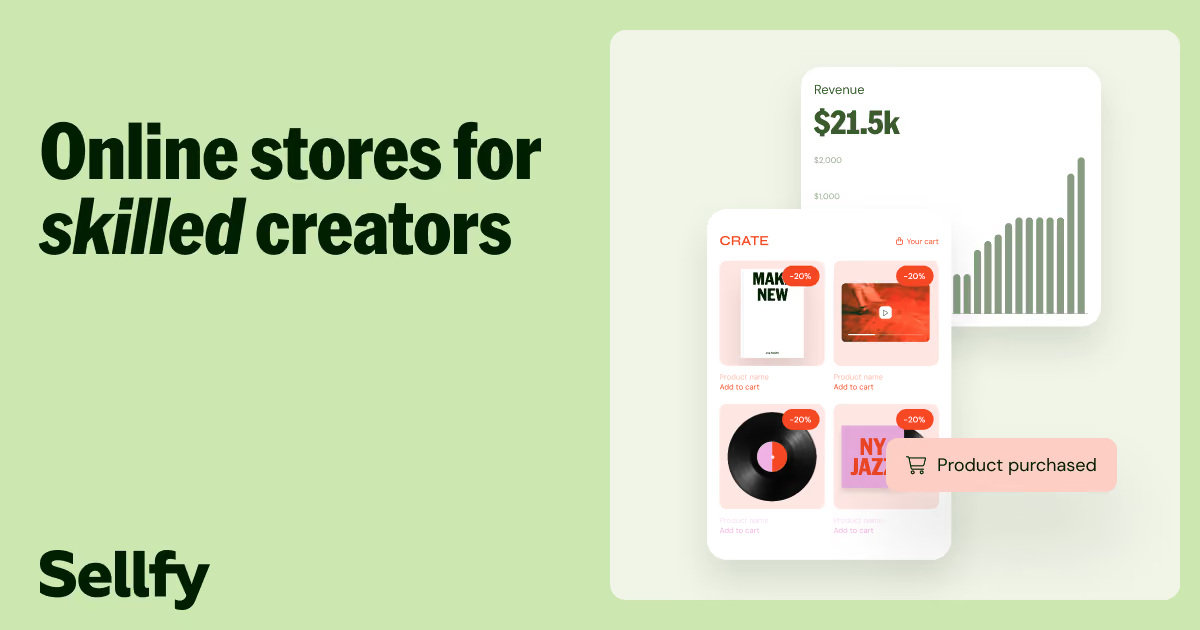
Sellfy is a store builder for creators, and its headline promise is a fixed monthly bill with no cut of your sales. The company says over 75,000 creators and businesses have earned more than $165 million through it. The catch is that "0% fees" moves the cost into the plan price. Sellfy caps each plan by yearly sales, so a growing store climbs the ladder whether or not it needs the extra features.
This review is for creators choosing between Sellfy, Gumroad, Payhip, Lemon Squeezy and Shopify for downloads, courses, presets, merch or memberships. It covers what each Sellfy plan includes, how the sales caps and the overage fee work, and what a store pays per month at three sales levels once card processing is counted. Retailpresso runs no test store, so every figure comes from Sellfy's pricing page and help center, and from each competitor's own pricing or fee page.
What is Sellfy?
Sellfy is a hosted storefront and checkout for digital products, physical products, subscriptions and print-on-demand merch, all sold from one store. Every plan includes unlimited products and all four product types, per Sellfy's plan comparison. A digital product can hold up to 50 files, and the maximum file size is 10 GB on Starter, 15 GB on Business and 20 GB on Premium.
You do not need a website. A Sellfy store works on its own and links from TikTok, Instagram or YouTube, or you can embed buy buttons, product widgets or the whole store on a site you already run. Every plan connects your own domain, takes custom code, and includes coupon codes, customer reviews and built-in email marketing. In 2026 Sellfy also added an MCP server on every plan and the trial, so an AI app such as Claude can draft listings, report sales and write buyer emails from your store data, per Sellfy's MCP page.
How Sellfy works
Payments go straight to your own Stripe or PayPal account, with no holding period, and Sellfy takes nothing per order. Card processing is the fee you still pay on every sale: Sellfy's Stripe help article puts it at 2.9% + 30 cents on average, which matches the domestic card rate on Stripe's US pricing page. International cards add 1.5% at Stripe.
Sellfy is not your merchant of record. You are the seller on the customer's statement, you own the customer data, and you handle sales tax and VAT yourself with Sellfy's tax settings, per its merchant of record article. Gumroad and Lemon Squeezy take on that tax work, which is part of why they charge a percentage. For print-on-demand, Sellfy charges you the base cost, shipping and taxes only after your customer has paid, so merch carries no upfront cost.
Every plan starts with a 14-day trial, during which the checkout runs in test mode, and you then have 30 days to upgrade before the account is deleted. Sellfy refunds a subscription payment if you cancel within 30 days of subscribing, per its billing article. Cancel later and the store runs to the end of the paid cycle, then your uploaded files are deleted 30 days after the plan ends.
Sellfy key features
Sellfy pricing
Sellfy prices by sales volume, so the real question is which cap your store sits under. Starter covers up to $10,000 in sales over the last 12 months, Business up to $50,000 and Premium up to $200,000, per Sellfy's revenue limit article. Stores that outgrow Premium can ask for a custom plan. Yearly billing saves about a quarter: 12 months of Starter cost $264 billed yearly against $348 on monthly billing, Business $708 against $948, and Premium $1,428 against $1,908, on our arithmetic from the per-month prices on Sellfy's pricing page.
The 2% overage fee is the hidden lever. If your trailing 12-month sales pass your plan's cap and you do not upgrade, Sellfy charges 2% on every later order and keeps your store open. A yearly Starter store that passes the cap pays $444 a year less in plan fees than yearly Business, so on our arithmetic the overage costs less than the upgrade until yearly sales reach about $32,000. Staying on Starter keeps you without upsells, cart abandonment and the affiliate program, and Sellfy expects an upgrade, so treat this as a bridge rather than a plan.
Our scenario: a creator selling $25 digital products to US buyers by card, at $500, $2,000 and $4,000 a month in sales. Sellfy, Payhip and Shopify add Stripe's 2.9% + 30 cents; Gumroad adds 10% + 50 cents on top of that card rate; Lemon Squeezy's 5% + 50 cents already covers processing. All totals below are our arithmetic, before sales tax, refunds and chargebacks.
| Platform and plan | $500 a month (20 orders) | $2,000 a month (80 orders) | $4,000 a month (160 orders) |
|---|---|---|---|
| Sellfy, billed yearly (Starter, then Business) | $42.50 | $141 | $223 |
| Sellfy, billed monthly (Starter, then Business) | $49.50 | $161 | $243 |
| Gumroad, direct sales | $80.50 | $322 | $644 |
| Payhip, cheapest plan at each level | $45.50 (Free) | $151 (Plus) | $263 (Pro) |
| Lemon Squeezy | $35 | $140 | $280 |
| Shopify Basic, billed yearly | $49.50 | $111 | $193 |
Three things stand out. Lemon Squeezy is cheapest at $500 a month and nearly ties yearly Sellfy at $2,000. Past roughly $2,035 a month at this order size, yearly Business beats it, and the gap widens with every sale. Gumroad's 10% fee makes it the most expensive option at every level. Shopify Basic costs less than Sellfy above Starter because its entry plan has no sales cap; Sellfy's case there rests on print-on-demand fulfillment, upsells and affiliates bundled in one creator plan.
Methodology: we read Sellfy's pricing page and its help articles on billing, revenue limits, email credits and discontinued plans on November 4, 2026. Competitor figures come from Gumroad's fees article, Payhip's billing article, Lemon Squeezy's pricing page and fee docs, Shopify's pricing page and Stripe's US pricing, read the same day.
| Plan | Price | Best for |
|---|---|---|
| Starter | $29/month, or $22/month billed yearly | Up to $10,000 in yearly sales, unlimited products, 10 GB files, 2,000 email credits a month, own domain, coupons and reviews |
| Business | $79/month, or $59/month billed yearly | Up to $50,000 in yearly sales, 15 GB files, 10,000 email credits, upselling, cart abandonment, affiliates, branding removal, migration help |
| Premium | $159/month, or $119/month billed yearly | Up to $200,000 in yearly sales, 20 GB files, 50,000 email credits, every Business feature plus priority support |
| Custom | Contact sales | For stores that outgrow Premium's yearly sales cap, priced on request |
| Overage fee | 2% per order | Charged on orders placed after your trailing 12-month sales pass your plan's cap, until you upgrade |
| Extra email credits | $2 per 1,000 | Minimum purchase of 2,500 credits; plan credits renew monthly and do not roll over |
Sellfy pros and cons
What we like
- No Sellfy transaction fee, so at $4,000 a month yearly Business costs $57 less than Lemon Squeezy on our arithmetic.
- Digital, physical, subscription and print-on-demand products share one cart, with unlimited products on every plan.
- Email credits included: 2,000 a month on Starter and 10,000 on Business.
What could be better
- Plans are capped by yearly sales, with a 2% overage fee on orders past the cap.
- No free plan for new sellers, and the trial checkout runs in test mode only.
- You are the merchant of record, so sales tax and VAT filing stay with you.
Who Sellfy is for
Sellfy fits a creator with a steady audience who sells a mix of products from one store. A YouTuber selling presets, a course and a hoodie can run all three through one cart, with merch printed per order and email included. Payouts land in your own Stripe or PayPal account at once, which suits creators who want the customer relationship and the cash flow in their own hands.
It is a weaker fit at both ends of the volume range. A seller doing a few hundred dollars a month pays less on Payhip's free plan, where the fee only applies when something sells; Lemon Squeezy also costs less at that level, but it closed to new sellers on November 16, 2026. A store selling mainly physical goods gets more for less from Shopify, whose entry plan has no sales cap. Sellers in the EU or UK should weigh the merchant of record point: on Sellfy you collect and file VAT yourself, while Gumroad does it for you.
Long-time users should check before switching plans. Sellfy's old Free plan closed to new sellers in November 2022, and accounts still on it or on the discontinued Pro or Pro Plus plans cannot return to them after an upgrade or a lapsed payment, per Sellfy's discontinued plans article.
Best Sellfy alternatives
If Sellfy is not the right fit, these are the closest options.
| Tool | Best for | Starts at | |
|---|---|---|---|
| Sellfy | Creators selling digital products, merch and subscriptions from one store, past a few hundred dollars a month. | Starter $29/mo · Business $79/mo · Premium $159/mo | Visit → |
| Lemon Squeezy | Existing Lemon Squeezy sellers only: closed to new sign-ups since November 16, 2026, shutting down March 31, 2027. | No monthly fee | Visit → |
| Payhip | Creators who want every feature on a free plan and to pay only when sales start. | Plus $29/mo · Pro $99/mo · custom-priced plans too | Visit → |
| Gumroad | New creators testing a first product who want no monthly bill and a marketplace audience. | No monthly fee | Visit → |
| Shopify | Sellers whose catalog is mostly physical products and who expect to grow without plan caps. | Basic $39/mo · Grow $105/mo · Advanced $399/mo | Visit → |


The bottom line
Sellfy is worth it once a creator store sells about $2,000 a month or more. From that point yearly billing on Business beats Lemon Squeezy at a $25 order size, and it beats Gumroad at every level we priced. Below that, pay-per-sale platforms cost less, and a store under the Starter cap should compare Starter's yearly rate with Payhip's free plan before committing; Lemon Squeezy, cheaper at that level, no longer takes new sellers. Pay yearly only once your volume is settled, because downgrades wait for the end of the billing cycle.
Skip Sellfy if you sell mostly physical goods, if you want someone else to file sales tax and VAT, or if your sales swing so much that a fixed plan feels heavy in slow months. For physical-first stores read the Shopify review, Shopify pricing and the Big Cartel review. For merch, see Printify, Printful, best print-on-demand services and how to start a print-on-demand business. Cost comparisons live in the cheapest ecommerce platform, free ecommerce website options and best ecommerce platforms, and how to reduce cart abandonment covers the feature Sellfy holds back for Business. Directory records: Sellfy, Gumroad, Payhip, Lemon Squeezy and Shopify on Toolradar.
Cite this: Retailpresso, 'Sellfy Review 2026: Pricing, 0% Fees, Pros and Cons', November 2026.
Frequently asked questions
How much does Sellfy cost in 2026?
Does Sellfy really have 0% transaction fees?
Does Sellfy have a free plan?
Is Sellfy cheaper than Gumroad?
What happens if I go over Sellfy's sales limit?
Sources
Prices and plan details come from each vendor's own pricing page, re-checked by the Toolradar pricing tracker.
- Sellfy pricingchecked Sep 2026
- Gumroad pricingchecked Sep 2026
- Shopify pricingchecked Sep 2026
Some offers on this page may be paid placements or contain affiliate links.
More Retailpresso reviews
Buyer guides and software reviews, with prices read from each vendor's own pricing page.
Browse all reviews